
Food Noise
The quiet mental loop that drains focus and peace around food.
You are not tired of dieting. You are tired of thinking about food all day.

Should I eat. Should I wait. Why am I hungry again.
Even when you are not physically hungry, food is there.
That is food noise.
It is not a discipline issue. It is a signaling issue.
When stress rises, sleep drops, or blood sugar swings, the brain increases vigilance around quick energy. Research in stress physiology and dopamine regulation shows that unstable internal signaling amplifies urgency-driven behavior and increases reward sensitivity toward food.
Food becomes louder.
At Mirabae, we do not fight hunger.
We stabilize the signal behind it.
When the signal steadies, the noise softens.

Why It Happens
Your brain prioritizes survival.
When glucose fluctuates, cortisol rises, or sleep is fragmented, reward sensitivity increases. Controlled laboratory studies show that even short-term sleep restriction can heighten food focus and alter reward processing. The brain interprets instability as potential threat and elevates attention toward fast energy sources.
When signaling feels unstable:
- Blood sugar swings amplify cravings
- Stress hormones distort hunger cues
- Sleep restriction increases reward sensitivity
- Dopamine volatility heightens urgency
This is not weakness.
It is neural protection.
The tighter the control, the louder the negotiation.

A Different Approach
Most solutions attempt to suppress appetite.
Suppression may reduce intake temporarily, but it does not stabilize the internal signaling that created the urgency in the first place.
Mirabae addresses the upstream drivers.
Instead of controlling hunger, we regulate the systems that generate it. Instead of fighting cravings, we restore biological steadiness.
When stress stabilizes and energy becomes predictable, urgency declines naturally.
Regulation replaces negotiation.
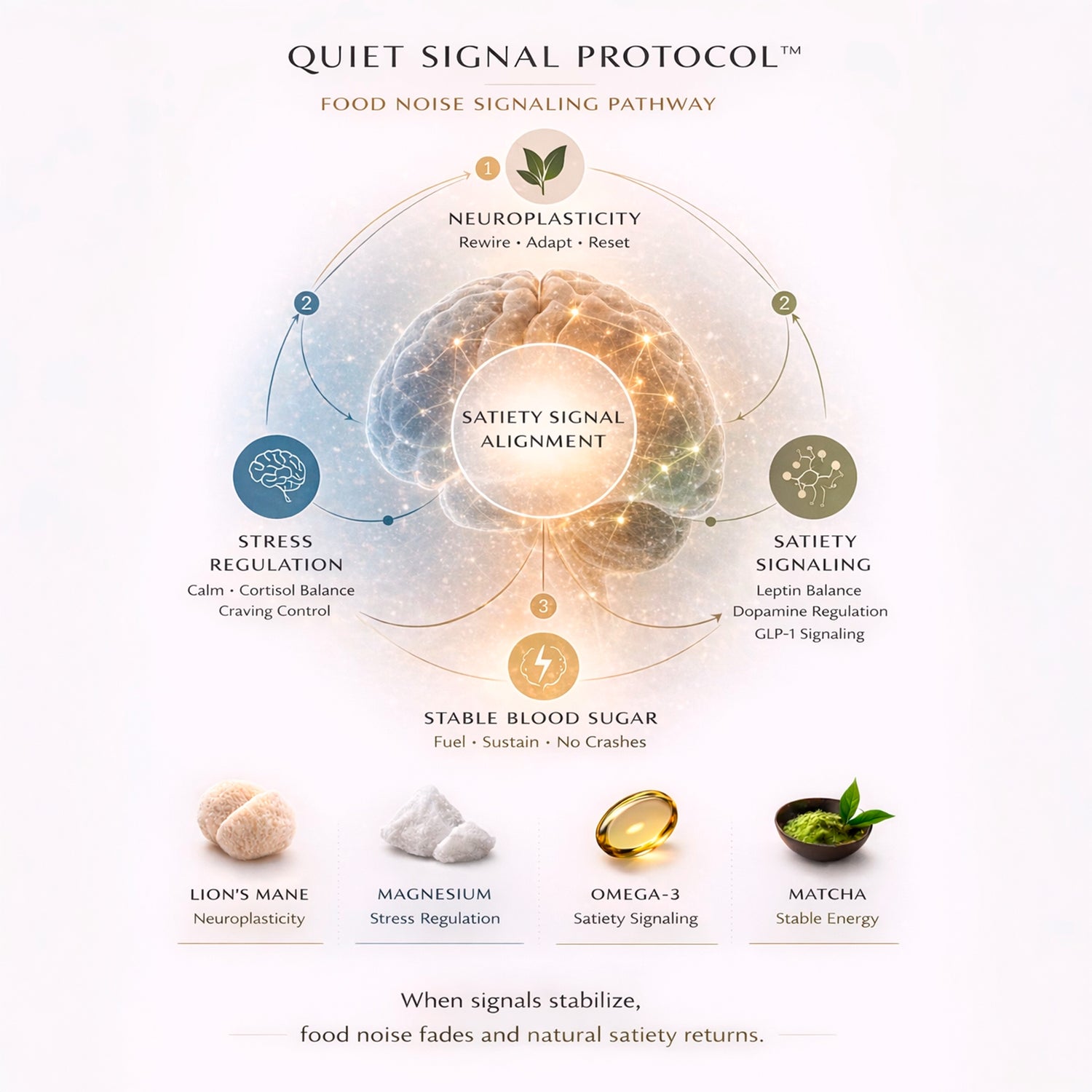
The Quiet Signal Protocol™
Food noise is not random. It is a feedback loop.
The Quiet Signal Protocol™ is Mirabae’s structured framework for interrupting that loop at its biological source.
The protocol works across three regulatory pillars:
This is not appetite suppression.
It is signal stabilization.
When these systems align, food becomes quieter.

How You Apply the Protocol
Understanding the mechanism is powerful.
Applying it is transformative.
You support the protocol by:
- Stabilizing blood sugar through structured nourishment
- Regulating stress through nervous system recovery
- Supporting neurotransmitter balance through targeted, evidence-informed supplementation
Each Mirabae ritual is designed to reinforce one of these regulatory pathways.
You are not suppressing appetite.
You are supporting the system that governs it.
When the brain feels biologically safe, urgency declines.

Begin Your Reset
If food noise has been quietly shaping your decisions, this is where the shift begins.
Start with the pathway most relevant to you: stress, sleep, clarity, or energy.
Join our email list to receive the Mirabae Food Noise Guide, an introduction to the Quiet Signal Protocol that explains why food noise happens and how stabilizing the brain’s signals can help quiet constant food thoughts, restore steady energy, and support healthy weight regulation.
Food noise does not disappear through discipline. It quiets when regulation replaces restriction.
Targeted Rituals for Food Noise
These rituals translate biology into daily practice.

Nervous System Calm
Magnesium Glycinate
Supports relaxation and recovery pathways linked to stress regulation, helping reduce background vigilance and stress-amplified appetite signaling.

Brain and Skin Support
Omega-3 EPA 180 mg + DHA 120 mg
Supports neuronal membrane integrity and balanced mood regulation, contributing to steadier reward signaling and emotional response.

Calm Focus Energy
Ceremonial Matcha
Combines caffeine with L theanine to promote steady alertness without sharp crashes that increase reward-driven food seeking.

Mental Clarity Support
Lion’s Mane Mushroom
Supports cognitive resilience and neural steadiness, helping soften fixation intensity and improve mental clarity.
Frequently Asked Questions
Is food noise just emotional eating?
Emotional eating can be one expression of it, but food noise refers more broadly to persistent mental preoccupation driven by unstable internal signaling rather than lack of willpower.
How long does stabilization take?
Many people notice subtle shifts within several weeks as sleep, stress, and energy patterns become more consistent. Biological regulation builds gradually through repetition, not intensity.
Do I need all rituals together?
No. Begin with the pathway most relevant to your current imbalance. Precision often works better than overload.
A Note on Consistency
Biological stability builds through consistency, not force. Commit to your chosen ritual for at least thirty days to allow signaling patterns to recalibrate.
This framework is educational and designed to complement a healthy lifestyle. It is not a substitute for individualized medical care.
When food noise quiets, something shifts.
Hunger feels physical.
Food becomes neutral.
Mental space returns.
You do not need more discipline. You need biological alignment.
Begin with the ritual your system needs most.